

The Development History of Chinese Fighter Aircraft
Release time: 2025-12-15
Looking back at the development history of Chinese fighter jets, it can be said to be a magnificent epic from being “out of reach” to being “far behind”, and now “competing on the same stage”. This is not just the growth of an industrial sector, but also a microcosm of a country defending its airspace sovereignty and pursuing technological self-reliance and self-improvement.
The Development History of Chinese Fighter Aircraft
2025-12-13 23:03 · Starting from Yu
Work statement: The content is sourced from the internet
Looking back at the development history of Chinese fighter jets, it can be said to be a magnificent epic from being “out of reach” to being “far behind”, and now “competing on the same stage”. This is not just the growth of an industrial sector, but also a microcosm of a country defending its airspace sovereignty and pursuing technological self-reliance and self-improvement.

- Starting from scratch: the era of imitation and striving for excellence
In the early days of the founding of the People’s Republic of China, our aviation industry foundation was extremely weak. In the initial stage, we mainly established an industrial system by introducing and imitating Soviet fighter jets.
*J-5 (first generation): It made its successful maiden flight in 1956 and was China’s first jet fighter. Its birth ended the history of China’s inability to manufacture fighter jets. In the homeland air defense operations at that time, the J-5 had repeatedly shot down invading enemy planes, achieving great military achievements.
*J-6 and J-7 (second generation): Subsequently, China entered the supersonic era.
*The J-6 is China’s first supersonic fighter jet, and also the most equipped and longest serving model, serving as the “air defense pillar” of that era.
*The J-7 was a product that was copied and continuously improved based on the MiG-21. Although it had a difficult start (due to a lack of complete technical data at the time), China completed the entire process of introduction, digestion, and absorption through a “cat and tiger” like study.

- Milestones of independent development: from “rolling and crawling” to “striving machine”
Merely copying cannot meet national defense needs, and Chinese aviation personnel have embarked on a difficult path of independent design.
*J-8 (Second Generation/Transition): This is China’s first self-designed high-altitude and high-speed fighter jet. Its development process was very bumpy, and it was called “rolling and crawling” by the chief engineer, Academician Gu Songfen. Although there is still a gap in performance compared to the world’s top level at that time, it marks a crucial step for China’s aviation industry to take in independent design.
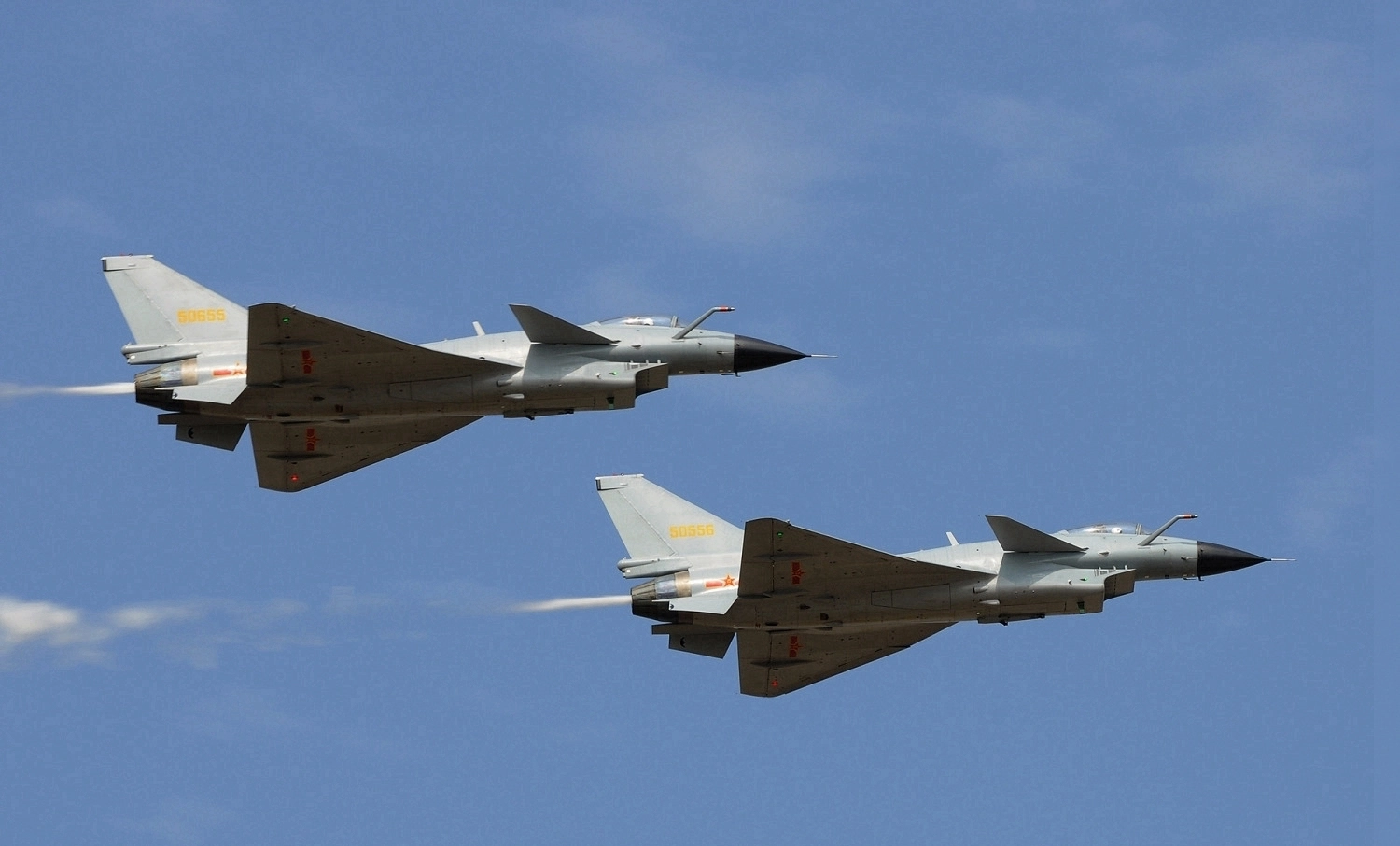
*J-10 (Third Generation/”Zhengqi Aircraft”): This is an epoch-making turning point. The J-10, which made its maiden flight in 1998, was China’s first independently developed third-generation fighter jet (according to Western standards). It adopts advanced duck style aerodynamic layout and full authority digital fly by wire control system. In order to develop it, Chinese aviation personnel have put in tremendous effort, and it is affectionately known as the “fighter jet”, marking that China finally has a fighter jet that can rival the world’s advanced level.
⚔️ 3. Leapfrog development: towards “both offense and defense”
In the 21st century, especially in the past decade, the development of Chinese fighter jets has entered the “fast lane”, achieving a leap from land to sea and from non stealth to stealth.
*Heavy duty twin heroes: the J-11 series (based on the deep localization improvement of the Su-27) and the J-16 (“bomb truck”), constitute a powerful heavy multi-purpose fighter group of the Chinese Air Force, with extremely strong air, ground, and sea strike capabilities.
*Carrier based aircraft: The successful maiden flight and deployment of the J-15 enabled the Chinese Navy to make a leap from land-based fixed wing fighter jets to ship based ones, filling the gap in carrier combat effectiveness.
The Development History of Chinese Fighter Aircraft

- Entering the ‘invisible era’: competing on the same stage
Nowadays, China has become one of the world’s leading aviation powers, possessing a family of stealth fighter jets that have attracted global attention.
*The J-20 (fifth generation): As a new generation stealth fighter, the maiden flight and deployment of the J-20 are the pinnacle of China’s aviation industry. It has high stealth, high situational awareness, and high maneuverability, making it the most powerful guardian of China’s airspace.
*J-35A (Fifth Generation): With the debut of the J-35A at the air show, the Chinese Air Force has become the second military in the world to equip two stealth fighter jets simultaneously, marking a more complete systematic construction of our air power.
Overview of the Development of China’s Main Fighter Aircraft
In order to give you a more intuitive understanding of these ‘airborne war eagles’, I have compiled the following table:
Code name, nickname/alternative name, historical status and characteristics
The J-5 subsonic defender is China’s first jet fighter, marking the beginning of China’s manufacturing of jet fighters.
The J-6 Farmer, China’s first supersonic fighter jet, has outstanding military achievements and is the “veteran” with the largest number of equipment.
The J-10 Raptors, the first third-generation fighter jet independently developed by China, is truly a “fighter jet”.
The J-15 Flying Shark, China’s first generation carrier based fighter, achieved a breakthrough from zero to one in fixed wing carrier based aircraft.
The J-20 Weilong, a new generation stealth fighter independently developed by China, represents the highest level of combat capability of the current Air Force.
summary
The development history of Chinese fighter jets, from the simple wish of “we must design our own aircraft” to the current “Eagle Eagle” spreading its wings and the “Mighty Dragon” roaring into the sky, is a struggle from “introduction and imitation” to “independent and controllable”, and then to “primitive innovation”.
The Chinese Air Force now has a large and advanced “War Eagle” family, which can not only effectively defend the security of the motherland’s airspace, but also demonstrate strong competitiveness on the international stage.